 English
 Italiano
 Español
 Français
Canon Criminal Law governs offenses and sanctions within the Catholic Church, a subject that is particularly relevant today because of the serious phenomenon of abuse. It is therefore essential to seek qualified assistance and legal advice in canonical criminal proceedings, both during the preliminary investigation and in the proceedings themselves, whether judicial or extrajudicial.
The actuality and centrality of matter
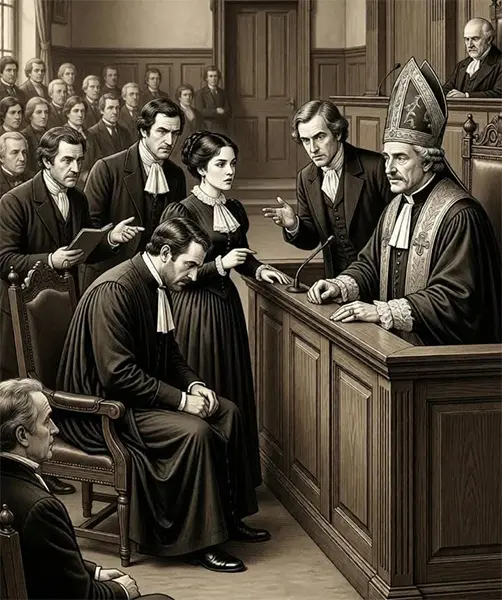
Today, the Church’s criminal law is at the center of profound legislative and media developments. In recent years alone, the following legislative measures may be noted: the Apostolic Constitution Pascite Gregem Dei, in force since 8 December 2021, which reformed Book VI of the Code of Canon Law; the Apostolic Constitution Praedicate Evangelium, in force since 5 June 2022, which reorganized the functions and competences of the Dicasteries of the Roman Curia; the Motu Proprio Vos estis lux mundi, promulgated on 9 May 2019, whose norms were subsequently expanded and made permanent on 25 March 2023, establishing universal procedures concerning abuse offenses and a reporting obligation for clerics and religious.
Jurisdiction in Criminal Matters
Canonical criminal proceedings fall within the jurisdiction of various ecclesiastical tribunals. In addition to local jurisdiction at the diocesan level, there are specific jurisdictions of the Holy See, before which the firm regularly practices, in particular:
- the Dicastery for the Doctrine of the Faith (DDF): pursuant to Articles 75-76 of the Apostolic Constitution Praedicate Evangelium and the applicable Normae de delictis reservatis it has exclusive competence over delicta graviora (more grave delict or crime), including abuse of minors and vulnerable adults, and offenses against the sacraments. It handles both extrajudicial proceedings and formal criminal trials.
- the Tribunal of the Roman Rota: acts as the supreme appellate tribunal (and, in rare cases, as a court of first instance) for offenses that do not fall within the exclusive competence of the DDF, ensuring observance of the law and the uniformity of the Church’s jurisprudence.
Protection and Defense in Abuse Cases
Recent papal reforms and the increased rigor introduced by the Holy See have made this area particularly central and sensitive. Global attention requires highly specialized technical knowledge in order to navigate procedures that are becoming increasingly specific and stringent.
Cases involving allegations of abuse—whether categorized as alleged abuses or involving individuals who are credibly accused—are highly complex and high-impact matters. As such, they must be handled with the utmost confidentiality, while simultaneously ensuring a specialized legal defense, which our firm has successfully provided in numerous cases.